Photo Management
Productivity
Technology
Why Construction Photos Mean Different Things to Different Stakeholders — And Why That Changes Everything
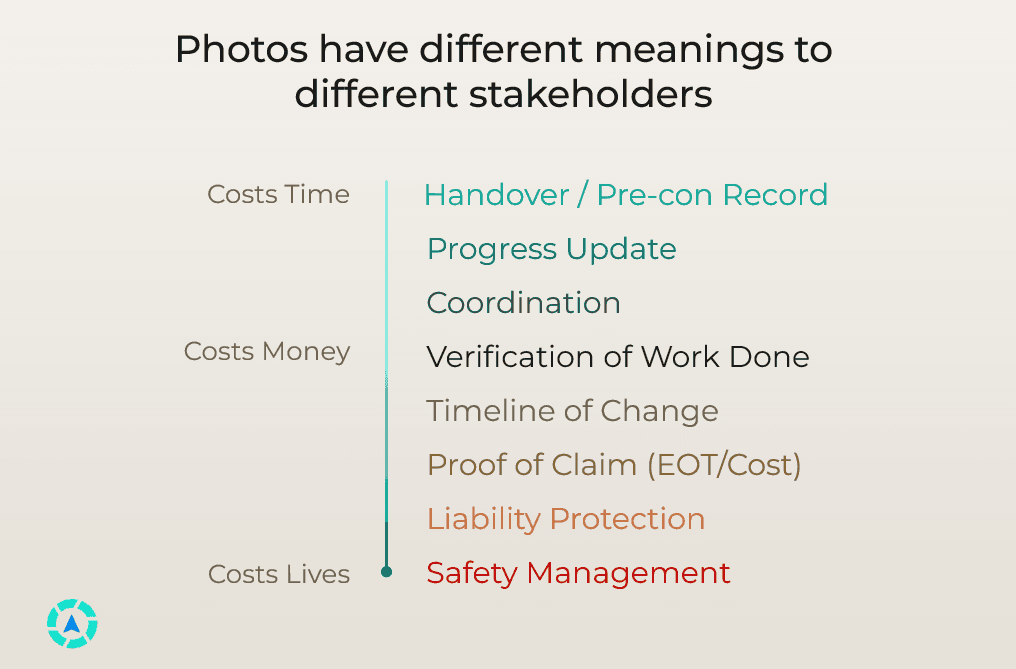
Image Credit:
Otus.build
Photos on Site Are Not Just Records — They Are Risk, Cost, and Control
On a construction site, a photo is never just a photo.
To a site supervisor, it is a quick progress update.
To a project manager, it is proof of work done.
To a commercial team, it can mean thousands of dollars in claims.
And in the worst cases, it becomes evidence tied to safety and lives.
The same image carries different weight depending on who is looking at it. That is where most construction teams underestimate the true value of construction photo documentation.
The Hidden Layers of Meaning Behind Site Photos
From Convenience to Critical Risk
Stakeholder Need | What the Photo Represents | Business Impact |
|---|---|---|
Handover / Pre-con record | Baseline condition | Avoid disputes later |
Progress update | Work status | Faster reporting, less admin |
Coordination | Visual clarity | Reduce rework |
Verification of work | Proof of completion | Payment approvals |
Timeline of change | Sequence tracking | Claim validation |
Proof of claim (EOT/Cost) | Legal evidence | Protect margins |
Liability protection | Accountability | Reduce legal exposure |
Safety management | Hazard identification | Protect lives |
At the top, photos save time.
At the bottom, they prevent fatalities.
Why Traditional Photo Management Fails
Despite the importance, most teams still rely on fragmented workflows:
WhatsApp groups for sharing updates
Scattered folders to store images
Manual tagging or no tagging at all
Reports created hours or days later
This creates three systemic issues:
1. Time Leakage
Teams spend hours searching, renaming, and organizing images instead of executing work.
2. Financial Risk
Missing or poorly documented photos weaken claims and delay payments.
3. Safety Blind Spots
Critical hazards are not tracked, escalated, or revisited properly.
Reframing Photos Using First Principles
If we break it down:
A construction photo is not an image.
It is data with context.
For it to be useful, it must answer:
Where was it taken?
When was it taken?
What does it relate to?
Who is responsible?
What action is required?
Without this metadata, a photo is just noise.
With it, it becomes a decision-making tool.
Ready to Build a Smarter Photo Culture on Site?
Otus is the construction photo app built by builders, for builders. Start for free with up to 3 projects — no credit card required.
Start your free project on Otus →
Or contact us to talk through the right plan for your site team.